Home PRODUCT/SERVICE Membrane
Membrane
Instructions for use
Bio-MEM Titanium Reinforced Membranes
Description
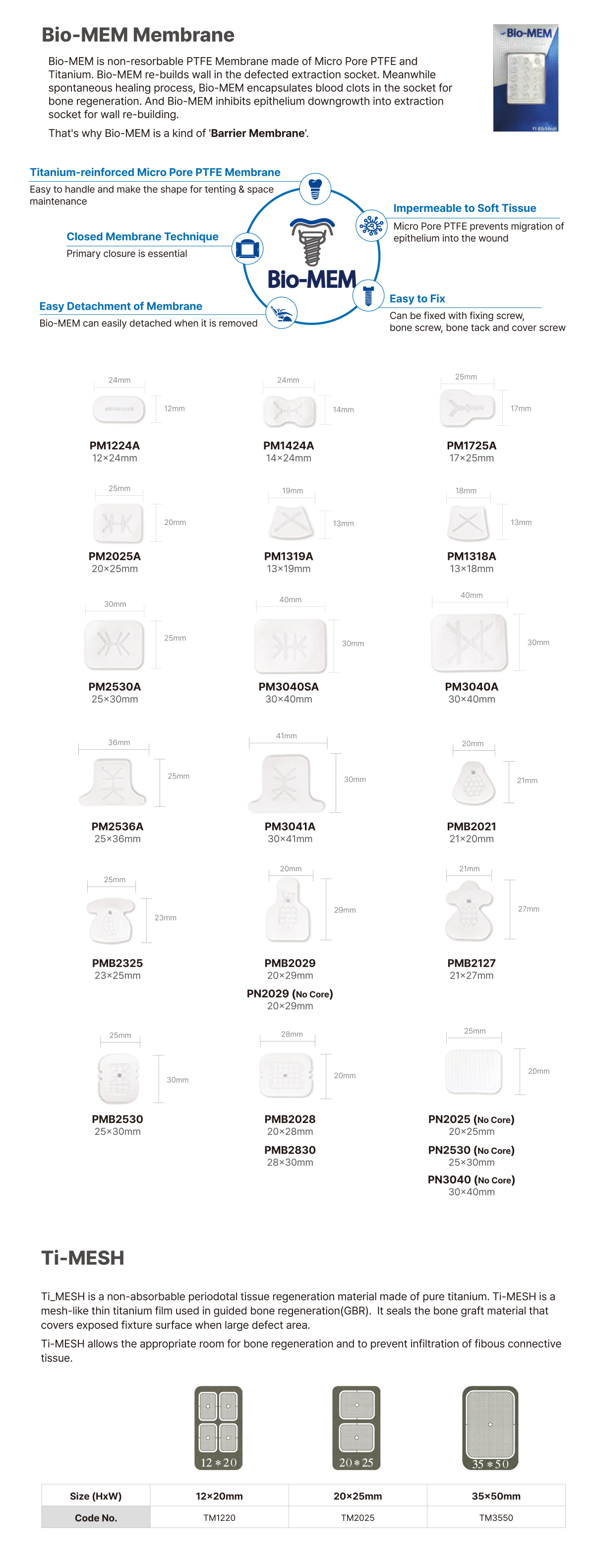
Bio-MEM Titanium Reinforced membranes are non-resorbable membranes available as Titanium reinforced configured of a highly shapeable Titanium (Reinforced only) enveloped by an embossed poly tetrafluoroethylene (PTFE) membrane. Extensive documentation demonstrates tissue compatibility of PTFE. Bio-MEM Titanium Reinforced membranes are designed to avoid ingrowth of gingival soft tissue into bony defects, in order to facilitate the neovascularization and bone formation during the repair process of the defect.
Bio-MEM Titanium Reinforced membranes are provided STERILE and in different anatomical shapes and sizes. The titanium reinforcement is intended for space creating and shape-maintaining which minimize movements and subsequent exposure during the regenerative healing.
Procedures
Please consult appropriate surgical and restorative manuals and textbooks for information on treatment planning and medical evaluation.
Opening the package
After removing the NON-STERILE pouch from box, carefully open the pouch and gently pour the STERILE membrane onto a sterile and clean surface. The sterile material should be handled using sterile gloves or atraumatic instruments.
Surgical considerations
· Sterile field should be maintained throughout procedure.
· Prepare a full thickness flap.
· Preserve interdental papillae if possible. · Allow a minimum distance to the dental root of approximately 1 mm.
· Remove pocket epithelium.
· Scale and smoothen the root surface, and debride the defect of any granulomatous tissue.
· Secure that site is free from active infections.
· Minimize saliva and other contaminants to the membrane and surgical site.
· Discard the device if dropped in the oral cavity.
· Chose the most suitable anatomical membrane configuration and size to minimize trimming.
· If necessary, trim membrane, allowing for adequate defect coverage.
· Shape the titanium reinforced membrane to conform to the desired volume, and the contours of the defect site and the adjacent bone.
· Avoid trimming the material within 1mm of the titanium if possible.
· Cover the defect area completely with the membrane.
· Stabilize the material, preferably by fastening pins or screws.
· Make every attempt to obtain primary closure over the material without over-stretching the flap after suturing.
Post-operative considerations and recommendations
Careful post-operative management is important for optimal healing, as with any oral surgical procedure:
· Avoid direct occlusal forces to the membrane. · Maintain oral hygiene following prescription by the clinician. This may include plaque control such as a gentle mechanical procedure or applying a chemical solution such as chlorhexidine.
· Guidelines on brushing or flossing as recommended by the clinician.
· Frequent patient monitoring and professional prophylaxis at least every other week for the first eight weeks.
· Exposure of the membrane can be expected. Do not attempt to cover exposed material. Monitor exposed membrane weekly.
· The membrane may be removed any time post -operatively following for example exposure, if deemed necessary by the clinician.
· Ideally, membrane that is placed in a submerged application should remain in place one to six months or until bone regeneration is complete. However, if exposed, it is recommended that shorter-term removal (at approximately four to twelve weeks) be accomplished to avoid comp romising the regenerative result.
· Peri-operative management may also include antibiotic therapy if deemed appropriate by the clinician. Systemic antibiotics could reduce post-operative complications.
· For complications which cannot be controlled by standard post-operative treatments, immediate membrane removal is recommended.
· A well tissue integrated membrane might require careful dissection and removal from the tissue to avoid layers of material being separated during removal.
· Debriding should be avoided within at least one year following guided tissue regeneration.
· Signs of tissue inflammation or confirmed infection may require removal of the membrane as recommended by the clinician and preferably followed by antibiotic treatment.
Indications for use
Bio-MEM Titanium Reinforced membranes are an implantable temporary non-resorbable device (membrane) for use as a spacer creation barrier in the treatment of local defects in the oral cavity in conjunction with tissue regeneration or augmentation. Bio-MEM Titanium Reinforced membranes are intended to be submerged and clinically implanted more than 30 days with an expected duration of implantation up of 6 months or until bone regeneration is complete.
Contraindications
Bio-MEM Titanium Reinforced membranes should not be placed where active infection exists. Prior to placement, the surgeon should assure that any active or recent infection has been properly treated. The membrane is not intended for use in load bearing or articulating situations such as temporal mandibular joint reconstruction. Failure to achieve this can lead to collapse of the membrane, early exposure and subsequent removal or reduced effect of treatment.
Precautions
Implantable temporary non-resorbable membranes, used to achieve tissue regeneration or augmentation should be used by persons trained in this method. Such training is offered at a number of centers. Long-term safety and effectiveness of using Bio-MEM Titanium Reinforced membranes in conjunction with bone filling materials has not yet been established. When using the membrane in combinations with other materials, the clinician should follow all instructions and cautions provided by each manufacturer. In conjunction with endosseous implants, Bio-MEM Titanium Reinforced membranes should only be used in combination with a stable implant and not as means of achieving primary implant stability. Patients can have medical conditions putting them at increased risk for complications following periodontal surgery. Patients with a heart valve or other prosthetic device, heart valve defects (i.e., heart murmur, prolapsed mitral valve, history of rheumatic heart disease, etc.) or uncontrollable diabetes are specific examples. Bio-MEM Titanium Reinforced membranes have not been tested in patients with a history of connective tissue disease or steroid use either at the time of treatment or for a one-year period prior to treatment. Because there is no information on these types of patients, the clinician should assess the risk and benefit for these patients and consider consulting with the patients’ physician prior to treatment.
Surgical Implantation Information
Selecting patients who will benefit from guided tissue regeneration requires detailed clinical judgment, which also applies when selecting and implanting the appropriate configuration for the defect, and treating patients postoperatively. This is covered in existing literature including publications in peer-reviewed journals. Good oral hygiene practices of the patient both pre- and postoperatively provides a good basis in the success of guided tissue regeneration.
Evaluation of results
Probing of sites treated with Bio-MEM Titanium Reinforced membranes should be avoided for at least six months. Effective measurements for determining the success of the procedure are to assess gain in attachment level, decreased probing pocket depth and overall health of the site. Regenerative healing has been shown to continue over 6 to 18 months post-surgery. Radiographs can be taken to evaluate the treatment result over this time frame.
Adverse effects
Bio-MEM Titanium Reinforced membranes do not have any known specific product related adverse effects. Non-resorbable membranes techniques have normal contraindications and risks including gingival recession, pain, swelling, inflammation, infection, loss of crestal bone height, perforation or abscess formation. Depending on the type and severity of the complication, as judged by the clinician, membrane removal or antibiotic therapy may be indicated.
Sterility
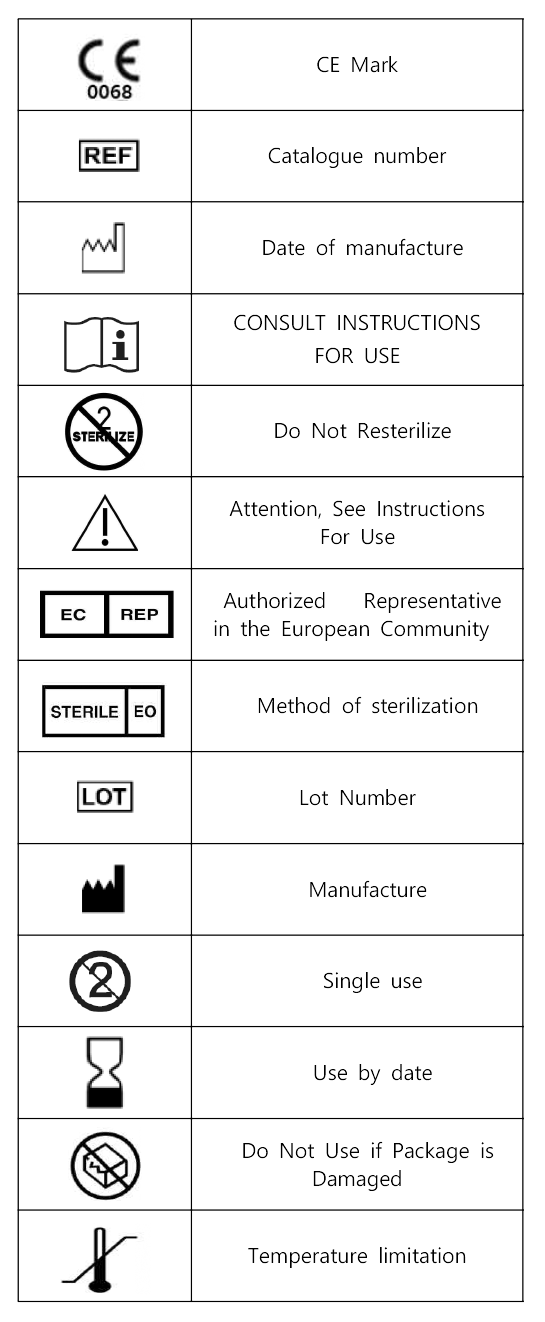
Bio-MEM Titanium Reinforced membranes are supplied STERILE and cannot be re-sterilized. Provided that the package is not compromised in any way, the package will serve as an effective sterile barrier until the “Use By” (expiration) date printed on the box.
Storage
Sterilized bags and unused components must be stored in dry environment, at room temperature and out of direct sunlight. Unused components must be stored in their original packaging.
Disposal
Explanted membranes should be handled as hazardous materials according to established procedures at the hospital/clinic.
Cautions
Federal (USA) law restricts the sale of this device to or on the order of a licensed physician or dentist. Do not re-sterilize Bio-MEM Titanium Reinforced membranes. The membranes must be used solely on one patient. Single use devices should not be reused due to risks of product contamination, patient/user infection and/or failure of the device to perform as intended. Care must be taken that membranes are not swallowed or aspirated by the patient. Bio-MEM Titanium Reinforced membranes are not intended as a permanent implant. It is designed to facilitate the regeneration of specific oral tissue and should be removed after function.In transgingival applications, early removal may be appropriate in the event of a complication. In the event of malfunction of the device or changes in its performance of the device, the patient should contact the dentist for assessment. Long-term porous biomaterial implants, placed via intra-oral incisions, have been associated with infections and exfoliation. In order to reduce the potential for post-operative infection, Bio-MEM Titanium Reinforced membranes should be removed after the material has performed its intended function. Early removal should always be considered if the site becomes compromised in any manner, which cannot be controlled by standard post- operative treatments.
MRI Safety Information
This device has not been evaluated for safety and compatibility in the MR environment. It has not been tested for heating, migration, or image artifact in the MR environment. The safety of this device in the MR environment is unknown. Scanning a patient who has this device may result in patient injury.
B&Medi Co., Ltd
56-33, Chukhang-daero 296beon-gil, Jung-gu, Incheon, 22339, Korea
Tel: +82-2-6295-0085 , Fax: +82-2-6295-0086
http://bnmedi.co.kr